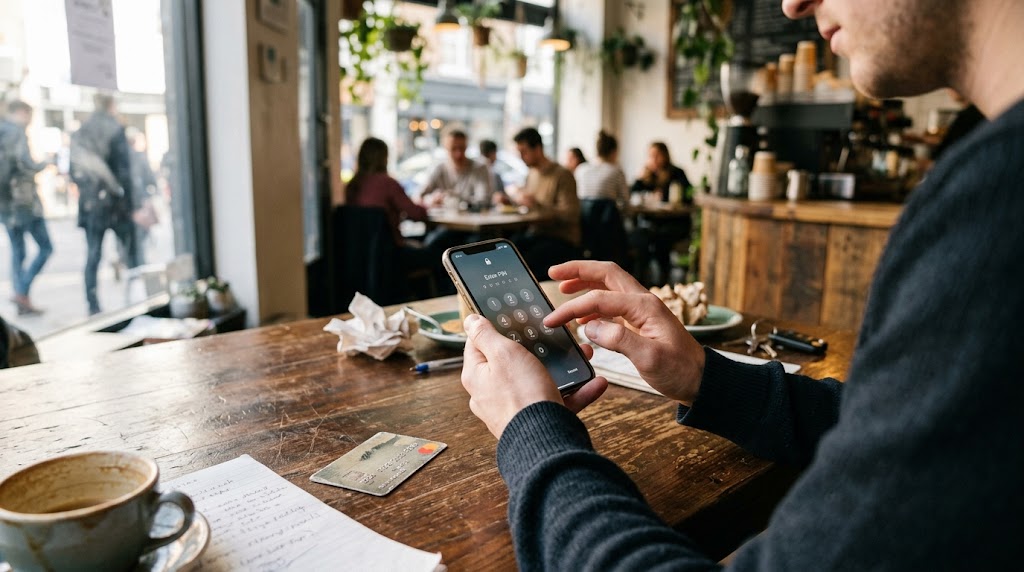
Most of us carry our entire financial and personal lives in our pockets. From our smartphones loaded with private photos to bank cards and mobile banking apps, everything is locked behind a seemingly secure wall of numbers. But what if that wall is made of paper? Although we trust our PIN to keep thieves at bay, many combinations are so obvious that malicious actors can guess them in mere seconds. If you are prioritizing convenience over security, you might be leaving the virtual door to your bank account wide open.
Key takeaways for securing your accounts
- Never use your birth year, day of birth, or an anniversary.
- Avoid simple geometric keypad lines – like 2580 or 1379.
- Switch to a six-digit code if your bank or mobile device allows it.
- Use distinct codes for your smartphone, banking applications, and physical cards.
The false security of four simple digits
A standard four-digit PIN offers exactly 10,000 possible combinations, ranging from 0000 to 9999. In theory, this sounds like a decent amount of mathematical protection. However, the flaw does not lie in the math, but in human psychology. People rarely choose numbers completely at random. Instead, they instinctively gravitate towards what is familiar, symmetrical, and easy to recall.
Security expert Nick Berry famously analyzed millions of leaked four-digit passwords to understand human habits. His findings were alarming. The sequence 1234 accounted for over 10 percent of all passwords analyzed. Other highly popular but incredibly risky choices included 0000, 1111, and 1212. If a criminal gets hold of your wallet, these are the absolute first numbers they will try to input at the nearest ATM.
Why personal dates and birthdays are the worst choice
One of the most common mistakes people make is using a date of birth, an anniversary, or a child’s birthday as their primary code. In their mind, it is the perfect solution – a number they will never forget, even in stressful situations.
However, in the modern age of digital footprints, your personal dates are far from private. A quick glance at your Facebook or Instagram profile can reveal your birthday through congratulatory posts, tagged photos, or public information sections. If your code is set in a simple DDMM (Day-Month) or YYYY (Year of birth) format, anyone who knows a little bit about you already has a massive head start. Years starting with 19 or 20 – like 1985 or 2001 – are notoriously overused and heavily targeted by cybercriminals.
Visual keypad patterns and the threat of shoulder surfing
Even if you actively avoid obvious sequences and birth dates, you might still fall into the trap of spatial patterns. Many users choose numbers that create a simple geometric shape on the numeric keypad. A classic example is 2580, which forms a straight vertical line right down the middle of a standard phone or ATM keypad. Other common choices include the four corners, such as 1379.
These visual patterns make you highly vulnerable to “shoulder surfing” – a technique where a criminal simply watches you enter your code from a distance. Because the finger movement is so distinct and rhythmic, they do not even need to clearly see the actual numbers on the screen to memorize your code.
Furthermore, using the exact same PIN to unlock your phone, access your banking app, and withdraw cash is a recipe for a digital disaster. If someone compromises just one of these access points, your entire ecosystem collapses.
How to create a bulletproof code for all your devices
While modern banking systems and smart devices feature security measures like temporary lockouts after too many failed attempts, a predictable PIN still drastically and unnecessarily increases your risk of a breach. Upgrading your security is a fast and simple process.
If your bank or device allows it, switch to a six-digit PIN immediately. A six-digit code increases the number of possible combinations from 10,000 to one million, giving you a hundred times more security. However, this rule only works if the numbers are genuinely random. A six-digit code like 123456 or 111111 is just as useless as a four-digit equivalent.
Memorization tricks for truly random numbers
When you switch to a random sequence, the biggest challenge is remembering it without writing it down. Instead of relying on a calendar date, try the word length method. Pick a four-word phrase that means something only to you – for example, “My dog loves jumping” – and count the letters in each word: 2, 3, 5, 7. Just like that, you have a completely random number (2357) that you can easily recall by repeating the secret phrase.
Alternatively, you can rely on muscle memory. Enter the new random number multiple times a day on a locked screen until your fingers simply remember the physical movement without your brain having to actively process the digits.
The final verdict on digital safety
In an era where cyber threats are constantly evolving and getting more sophisticated, relying on 1234 or your birth year is like locking your front door but leaving the key in the lock. Taking just five minutes today to update your banking and smartphone codes can save you from months of financial headache, stolen identity issues, and lost savings down the road.